
An independent guide
Order of the Sinking Star Developer & Design History
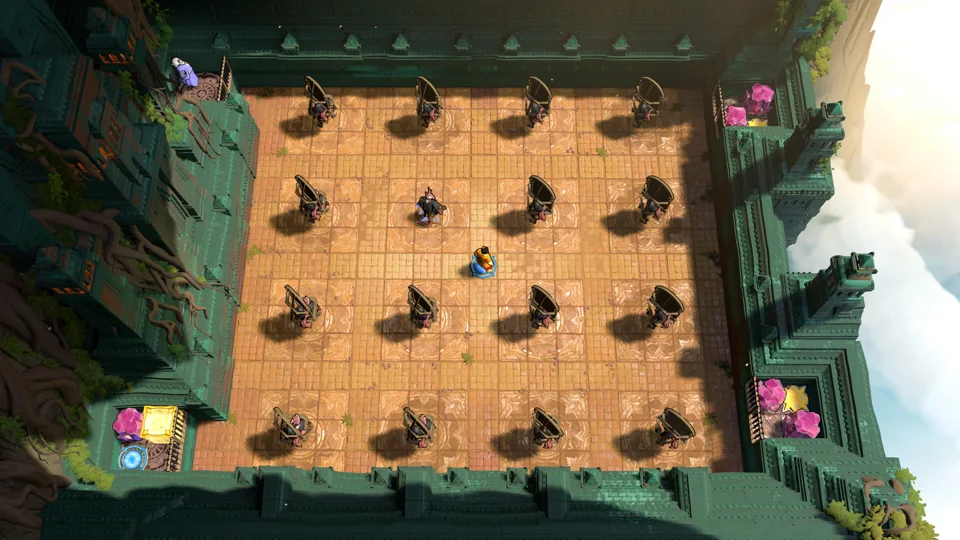
Order of the Sinking Star is developed by Thekla, Inc. and directed by Jonathan Blow, whose earlier games include Braid and The Witness. The Steam Windows listing names Arc Games and Gamirror Games as publishers; the US PS5 and Switch 2 listings name Arc Games. PLAYISM identifies Active Gaming Media as the licensed publisher of the Japanese console editions. The credits below separate those publishing roles from the designers whose games form the puzzle foundation.
- Publishing
- Official storefront and Japan license statements checked October 13, 2026. A Japan product listing does not confirm that edition has launched.
- Development claims
- Dated publisher descriptions and original interviews; approximate team size, technical plans and code measurements are kept separate.
Who develops, directs and publishes the game?
Roles named by the official game website, storefronts and Japan license statement. Publisher names are tied to the listed edition.
Scroll across to read every column.
| Role or edition | Named organization or person | What the credit establishes |
|---|---|---|
| Development studio | Thekla, Inc. | The studio that develops Order of the Sinking Star. |
| Game director | Jonathan Blow | The official release announcement identifies Blow as Thekla's founder and this game's director. |
| Steam Windows listing | Arc Games; Gamirror Games | Both names appear in the product's publisher field. |
| US PS5 and Nintendo Switch 2 listings | Arc Games | The publisher shown on these US console storefronts. |
| Japan PS5 and Nintendo Switch 2 editions | Active Gaming Media, through PLAYISM | The Japan product's license footer names Active Gaming Media as the licensed Japanese publisher. |
A publisher credit identifies an edition's publishing arrangement; it does not make that organization the development studio. The Japan footer still identifies Thekla as developer and Arc Games as the original publisher and distributor.
Sources: Steam — official developer, publishers and design credits · Official game website — developer and foundation FAQ · Arc Games — August 18 release-date announcement · PlayStation Store — US PS5 publisher listing · Nintendo — US Switch 2 publisher listing · PLAYISM — Japan console edition and license credit
The connection to Braid and The Witness
The official description introduces Blow through Braid and The Witness, while its development history places this project after The Witness. That establishes a creative lineage. It does not, by itself, establish a shared fictional world or a story sequel.
The new game's central design idea is to bring separate puzzle systems together. Its foundational designers therefore have a different relationship to the project from the director's previous games. For the practical differences between the two adventures, use the The Witness comparison.
Sources: Steam — official developer, publishers and design credits · Official game website — developer and foundation FAQ
The designers behind the puzzle foundation
Named foundation credits and further design contributions in the official Steam description. This is the published named set, not a full staff roll.
Scroll across to read every column.
| Designer | Work named in the description | Credit in this project |
|---|---|---|
| Alan Hazelden | Skipping Stones to Lonely Homes; Mirror Isles | Author of two of the four foundational titles or series. |
| Sean Barrett | Promesst 1–3 | Author of the foundational beam-and-cave puzzle series. |
| Jonah Ostroff | Heroes of Sokoban 1, 2 and 3 | Author of the foundational hero-class puzzle series. |
| Zach Polansky | Enigmash | Named for additional design contributions. |
| Patrick Traynor | Patrick's Parabox | Named for additional design contributions. |
| Marc ten Bosch | Miegakure | Named for additional design contributions. |
The official description also acknowledges other contributors, including Twitch followers over the years. The four foundation entries are Skipping Stones to Lonely Homes, Mirror Isles, Promesst 1–3 and Heroes of Sokoban 1–3; a numbered series occupies one foundation entry.
The foundation credit says these works inspire and comprise the beginning of the adventure, after which their systems combine. The Mirror Isles and foundational-games reference explains that relationship without turning an author credit into a room solution.
Sources: Steam — official developer, publishers and design credits · Official game website — developer and foundation FAQ · Arc Games — August 18 release-date announcement
What the dated development estimates mean
Corey Brotherson's July 21, 2026 PlayStation Blog report describes ten years of development and a team of around 20 people. Those are the report's approximate, pre-release descriptions; they are not an exact current headcount or a count of everyone credited over the project's lifetime.
In Nintendo Life's September 30 interview, Blow says the game started in 2016. The official history likewise describes development since The Witness. These statements explain the long development period without fixing an unsupported day-by-day production schedule.
Sources: PlayStation Blog — Corey Brotherson's July 21 hands-on report · Nintendo Life — September 30 interview with Jonathan Blow · Official game website — developer and foundation FAQ
Jai, the custom engine and future tool releases
Blow explains the custom technology in the Nintendo Life interview from 31:12. He describes dissatisfaction with programming in C++, developing a new language commonly called Jai, and building an engine to use that language for a substantial project. He also explains a trade-off: their own engine gives them control, while bringing it to Switch 2 requires explicit porting work.
The same September 30 interview describes the language as being in beta rather than publicly available at that time. GameCentral's December 12, 2025 reveal report had described a plan to release the language and engine free after the game. That future plan is not confirmation of a post-launch download; a public release of those tools has not been verified for this reference.
No reproducible line count for the shipped game's source is established here. A developer's reason for making a language, an approximate staff count, or a claimed improvement in programming speed cannot be converted into a measured code-size or compiler benchmark.
Sources: Nintendo Life — September 30 interview with Jonathan Blow · GameCentral — December 12, 2025 reveal report
Sources and scope
- Steam — official developer, publishers and design credits
US-region Windows product 499170; publisher fields and History, Foundation & Design Contributions. API fields also checked October 13.
Research checked
- Official game website — developer and foundation FAQ
Thekla, creative lineage and official foundation description.
Research checked
- Arc Games — August 18 release-date announcement
Official attribution of Blow as founder/director and named design contributions; pre-release announcement.
Research checked
- PlayStation Store — US PS5 publisher listing
US PS5 product's publisher field and legal credit.
Research checked
- Nintendo — US Switch 2 publisher listing
US digital Switch 2 edition, publisher and legal credit.
Research checked
- PLAYISM — Japan console edition and license credit
Japan PS5/Switch 2 product license statement; listing checked October 13 still uses a planned 2026 release.
Research checked
- PlayStation Blog — Corey Brotherson's July 21 hands-on report
Pre-release demo report; approximate ten-year development and around-20-person team description.
Research checked
- Nintendo Life — September 30 interview with Jonathan Blow
Arc Games-sponsored interview; developer's technical explanation at 31:12–36:15. Supplied footage is in-development; current playback not verified here.
Research checked
- GameCentral — December 12, 2025 reveal report
Original reporting of a future free language/engine release; not evidence that a public download has shipped.
Research checked